SUARASA: Coming Home to the Other Home
One dish, two artistic practices and the constellation that grew between them. A conversation with Myloan Dinh and Till Schmidt-Rimpler.
We began with food.
Myloan had prepared stir-fried noodles with pork, garlic, lemongrass, sesame oil, mushrooms, onions, yellow squash from Lutz’s garden, sambal and soy sauce. As we settled around the table at NOVILLA, the sounds of serving, eating, plates and cutlery entered the recording. They became part of the conversation before the conversation had properly begun.
This was an edition of Suarasa, my ongoing radio format in which food becomes a catalyst for listening. Usually, one dish accompanies one guest, one story and one musical selection. This time, I was sitting with two people whose stories could not easily be separated: Myloan Dinh and Till Schmidt-Rimpler, artists, partners and co-founders of Moving Poets.
I had arrived with two sets of questions. For Till, I wanted to understand Moving Poets as an artistic practice in itself. What does it mean to move from choreography towards the construction of an organisation, a collective and a cultural space? For Myloan, I wanted to speak about Boom Boom Butterfly, the work she will present as part of ALI(E/A)NSI.
One conversation concerned an artistic infrastructure built over decades. The other concerned a specific object: a pair of boxing gloves covered in fragments of eggshell.
Yet, as we spoke, the two lines continually crossed. The organisation, the artwork, the couple, their children and the house in which we were eating had all developed through one another. Instead of two parallel interviews, the conversation became an attempt to understand the constellation that holds these different practices together.
The third practice
Myloan and Till met at Café 521, an artists’ bar in Charlotte, North Carolina. Their relationship began through a proposition to collaborate. Before it was clear what they might become to one another personally, they had already begun testing how they could work together artistically.
As Till remembers it:
“The test, the date, was the project.”
The sentence appeared almost casually in the conversation, but it reveals something fundamental. Collaboration was not added to their relationship later. It was already one of its original languages.
Till came from ballet, theatre and choreography. Myloan had a visual-art practice and was accustomed to spending long periods working alone in the studio. Their encounter brought together not only different personalities, but also different ways of producing art: one grounded in bodies, timing and collective performance; the other in material, objects and individual concentration.
What began to emerge between them was neither entirely Till’s practice nor Myloan’s. It was something constructed in the space between the two: a third practice.
This third practice would eventually become Moving Poets.
Till describes its initial motivation as a frustration with the authoritarian structures he had encountered in conventional theatre and dance institutions. In those contexts, collaboration could be spoken about frequently while power continued to move primarily in one direction. Artists from different disciplines might be brought together, but they were often expected to execute a vision already determined by someone else.
Moving Poets began with the desire to create a different condition:
“At the heart of it was creating a platform that allows different artists to work with each other and create original work.”
The artistic work would not begin with a fixed aesthetic form. It would begin with an encounter among people carrying different histories, disciplines, abilities and positions. The task was to create enough structure for something to happen without deciding in advance exactly what that something should become.
At the centre of this approach, Till says, is storytelling:
“The nucleus is storytelling.”
Storytelling here does not necessarily mean producing a linear narrative. It means creating a shared point of departure from which sound, movement, image, text, performance and social relations can grow. The story can take many forms because no single discipline is asked to dominate it.
Choreographing conditions
If choreography is usually understood as the arrangement of bodies in time and space, Till’s practice seems to have gradually expanded the meaning of choreography. Moving Poets choreographs not only performances, but also conditions: people, rooms, resources, responsibilities, conflicts, invitations and durations.
The artistic material is therefore not limited to what eventually appears before an audience. It also includes the relationships that must be cultivated before a work can exist.
Till formulated this through one of the most resonant statements in our conversation:
“If we want to move people, we also have to allow ourselves to be moved.”
To be moved is not only to experience an emotional response. It means accepting the possibility that an encounter will alter the structure itself.
A cultural organisation can invite many artists while remaining fundamentally unchanged by their presence. It can display cultural difference without surrendering any control over its own narratives, working methods or distribution of power. Moving Poets proposes that invitation is only the beginning. The deeper question is whether those who enter are permitted to influence what the space will become.
This is also where Till’s collective practice meets Myloan’s position within Moving Poets. She is not simply the visual artist beside a choreographer, or the partner accompanying an institutional project. Her practice, perspective and labour have been part of the organisation’s formation. At the same time, Moving Poets has affected how she understands her own work.
Myloan spoke about coming from the relative solitude of the studio and entering a process in which a work had to encounter other bodies, disciplines and interpretations. Collaboration demanded a different kind of openness. An object could no longer be understood only through its maker’s original intention. It might become part of a performance, acquire another function or be transformed by the people around it.
The organisation and the individual practice have therefore not remained separate. Each has placed pressure on the other.
Keeping the house alive
This mutual transformation became especially material through NOVILLA.
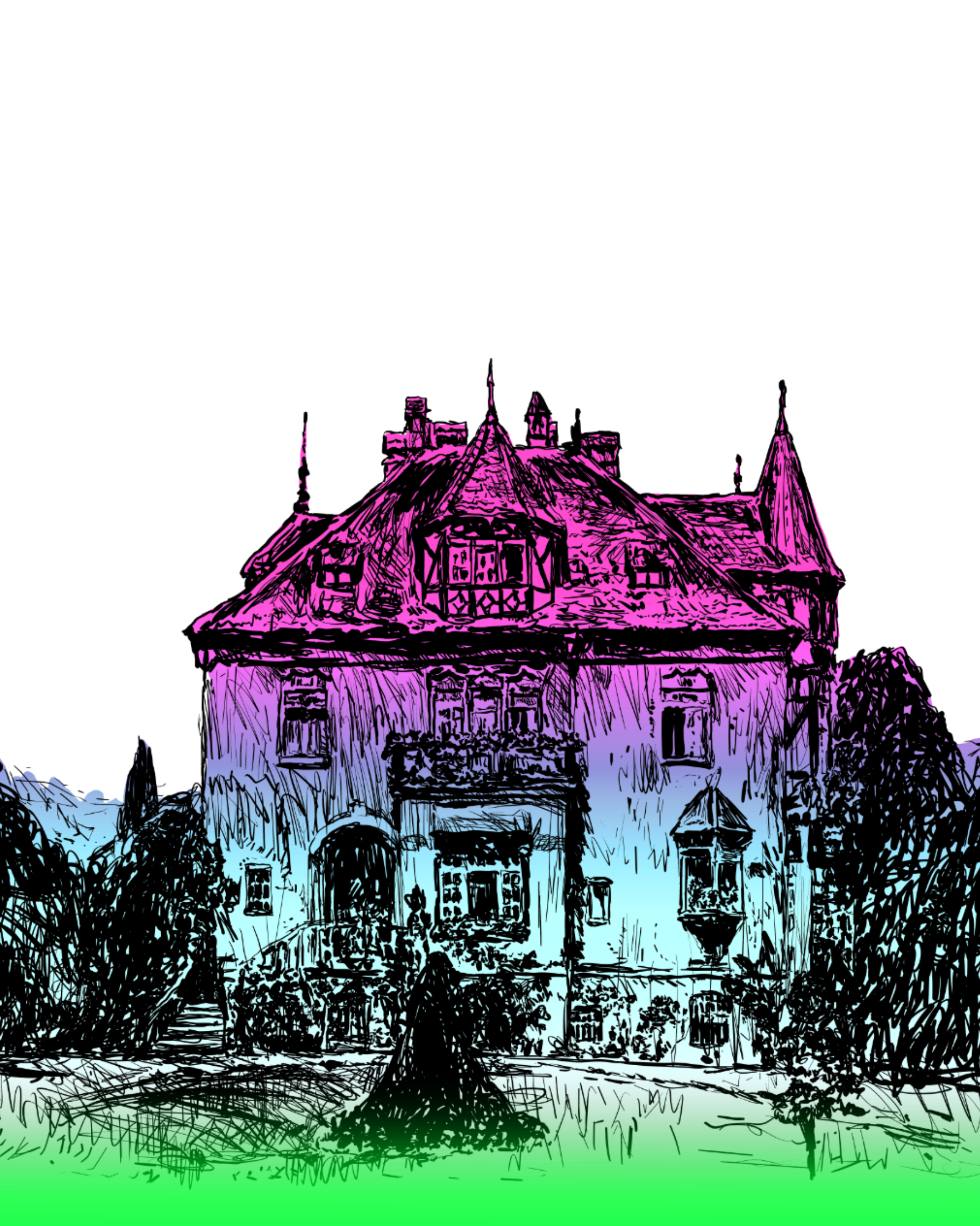
Moving Poets had previously occupied a former Robotron industrial building in Schöneweide. Later, around 2013, the collective discovered the villa. The building had its own uncertain history and future. At one point, it appeared likely to be sold to a developer. Political support arrived at a critical moment, but even after that intervention, the continued existence of NOVILLA was never guaranteed simply by securing access to the building.
A building is not yet a cultural space. It has to be continuously produced as one.
NOVILLA is often encountered through its visible activities: exhibitions, performances, concerts, rehearsals, workshops and gatherings. Our conversation, however, repeatedly returned to what remains less visible. Funding applications. Meetings. Repairs. Negotiations. Cleaning. Administration. Childcare. The gradual accumulation of trust.
When I asked which work is essential to maintaining the space but rarely seen by artists or audiences, the answer was immediate:
“Repairing the toilets.”
Then came the recurring questions:
“Who’s cleaning the bathrooms this time? Cleaning the floors? Mowing the lawn? Taking out the trash?”
These tasks might sound secondary to artistic practice, but without them the institution cannot survive. The alliance is not maintained by a shared vision alone. It depends upon people repeatedly accepting responsibility for the ordinary conditions of being together.
This does not mean romanticising unpaid or invisible labour. On the contrary, naming it makes it possible to ask how it is distributed, whose time it consumes and whose artistic work it enables. Every seemingly open cultural space contains these negotiations, even when they remain hidden behind the public programme.
For Myloan and Till, these negotiations have also been entangled with family life. Their children grew up around rehearsals, productions and the people involved in Moving Poets. Artistic colleagues became part of an extended social fabric. The line between collective, workplace, friendship network and family was never entirely stable.
NOVILLA consequently carries more than a programme. It holds traces of the different people who have entered it, worked within it, repaired it, disagreed inside it and changed its direction. It is less a completed institution than a living arrangement: one that must continually negotiate who it belongs to and who is permitted to transform it.
Force covered in fragility
After speaking about the collective, the organisation and the building, we returned to Myloan’s work Boom Boom Butterfly.
The work consists of boxing gloves covered with eggshell fragments using a technique connected to Vietnamese sơn mài lacquer. When positioned together, the gloves suggest two halves of a butterfly. Their shadows extend this transformation, allowing objects associated with striking, force and defence to appear as wings.
Myloan’s material relationship to lacquer is not based upon a simple recovery of an intact cultural tradition. It is closer to a form of latent exposure: something encountered through family, migration, images, objects and inherited histories before being consciously recognised as part of an artistic language.
Eggshell carries this complexity particularly well. It appears delicate, domestic and easily broken. Applied to boxing gloves, however, it does not simply soften them. Nor does it erase the violence associated with the object.
Myloan asks:
“What happens when you take an object that symbolizes something forceful and cover it with something as fragile as eggshell?”
The work does not provide a single answer. The shell might protect and decorate the gloves, but it could also crack when they are used. The boxing gloves contain the possibility of both violence and defence. The butterfly suggests delicacy, migration and transformation, but its symmetry is produced through objects built for combat.
Hardness and softness are not presented as opposites belonging to different bodies or identities. They remain present simultaneously.
As Myloan puts it:
“Life is not soft, and life is not really all hard.”
The work’s historical associations also resist a single reading. Boxing gloves may evoke masculinity, aggression and protection. The butterfly can be connected to femininity and transformation. Vietnamese lacquer carries histories of artistic knowledge, colonial encounters and displacement. The eggshell is both a humble material and a surface made through intensive, meticulous labour.
Rather than resolving these contradictions, Myloan allows them to remain visible on the same object.
This also affects how the work speaks about identity:
“Identity is not a fixed place either. It is an ongoing, ever-changing state.”
Identity here is not a stable origin waiting to be retrieved. Nor is migration a clean movement from one identity towards another. Materials, memories and techniques accumulate unevenly. Some are consciously carried. Others return much later, altered by distance and by the different lives through which they have travelled.
What a constellation holds
Presenting Boom Boom Butterfly at NOVILLA brings Myloan’s individual artistic practice into a space created through her shared history with Till and Moving Poets. But I do not see this simply as a homecoming. That word suggests a return to something stable, familiar and already waiting.
What happens here feels less conclusive.
The work enters a space that Myloan helped shape, but which has also changed through many other people. It arrives with histories that cannot be contained by one geography: Vietnam, the United States and Germany are present, but none can provide a final explanation. The work does not return to an origin. It creates another encounter between the places, relationships and materials that have formed it.
Perhaps this is what connects Boom Boom Butterfly to the wider practice of Moving Poets. Both exist through the tension between holding and changing.
A collective needs enough structure to hold people together, but enough openness to be transformed by them. A relationship requires continuity without freezing either person in place. An artwork carries material memory while allowing that memory to acquire unfamiliar forms. A house accumulates histories, yet remains unfinished.
What began as an artistic project between two people grew into a collective, a family, an organisation and a space inhabited by many others. It did not grow through a straight line or a single shared identity. It grew through repeated acts of alignment: sometimes intimate, sometimes institutional, sometimes as ordinary as cooking a meal or repairing a toilet.
Around the table at NOVILLA, these scales were present at once. The food Myloan prepared. The story of an early collaboration that was also a date. Till’s choreography of collective conditions. The labour required to sustain a house. A pair of boxing gloves becoming butterfly wings.
The constellation holds because its elements do not have to become the same. They remain distinct, exert pressure on one another and continue moving.
That movement may be the practice itself.
Leave a Reply