Catalyzing Coexistence
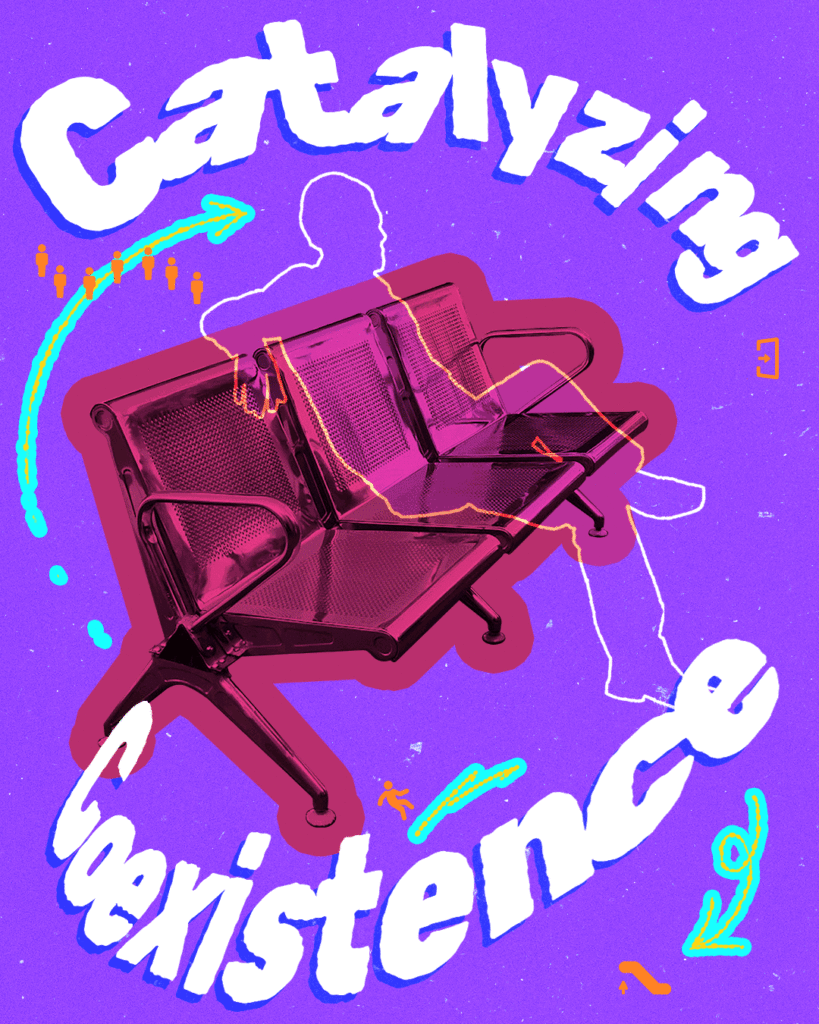
Artwork by https://aziza.fun/
About
Catalyzing Coexistence is a year-long curatorial and artistic initiative by sōydivision, developed as part of the broader trilogy Trustpiction (2025–2027). Moving across artistic practice, public gathering, and community based reflection, the project asks how coexistence is negotiated under conditions of precarity, fragmentation, and increasing social polarization. Rooted in Berlin’s diasporic and translocal cultural landscapes, the series reflects on how communities continue to build relations, solidarity, and shared cultural spaces while navigating unequal histories, political tensions, migration trajectories, and the shifting narratives surrounding diversity in Germany today.
Structured across four interconnected public chapters throughout 2026, Catalyzing Coexistence unfolds as a continuous process where each chapter informs and reshapes the next one. The first chapters focus on participatory gatherings and discourse based formats that question conventional symposium structures through collective listening, food related practices, storytelling, and informal encounters. These moments also function as spaces for collecting stories, references, recordings, and archival traces emerging from the gatherings themselves.
The later chapters continue this process through workshops, collaborative artistic experimentation, and exhibition making, transforming the accumulated materials and conversations into new artistic and collective forms. Rather than separating artistic production from social organizing, the project approaches them as intertwined practices of listening, negotiating, imagining, and collectively inhabiting complexity.
Hosted at Novilla by Moving Poets in Berlin-Schöneweide, the series brings together artists, researchers, musicians, organizers, and diaspora led initiatives to explore coexistence not as a fixed ideal, but as an ongoing process of friction, care, contradiction, and relation.
Curatorial Notes by sōydivision
Catalyzing Coexistence emerged simultaneously with the development of Trustpiction, sōydivision’s curatorial proposition unfolding between 2025 and 2027. Trustpiction grew from a long period of reflection around what we identify as the contemporary global polycrisis: ecological collapse, displacement, economic instability, social fragmentation, rising polarization, and the increasing instability shaping everyday life across different societies. Central to this proposition is the dialectic between trust and suspicion, and how these two forces increasingly structure social relations, political imaginaries, communities, and even artistic practices today.
Many of these reflections intensified during and after the COVID-19 pandemic, which for us felt like a historically strange and transformative moment. Alongside the isolation, fear, and uncertainty, there was also a temporary emergence of new solidarities and coalitions. During that period, we witnessed different social movements, diasporic communities, activist groups, and BIPOC-led initiatives finding unexpected forms of resonance and mutual support through movements responding to systemic injustice, including Black Lives Matter, anti-Asian hate organizing, migrant justice initiatives, and broader struggles against structural violence and exclusion. For a brief moment, it felt as if new possibilities for collective empathy, listening, and political alignment were becoming imaginable, particularly within artistic and cultural communities working around decoloniality, social justice, and institutional critique.
At the same time, these solidarities also revealed their fragility. Shortly after the war in Ukraine began, the controversies surrounding Documenta fifteen and the accusations of antisemitism directed toward parts of the exhibition became, for us, a significant turning point within the German cultural field. The debates, institutional reactions, public polarization, and atmosphere of suspicion deeply affected many artistic and diasporic communities that had previously attempted to build solidarities across different struggles and positions. Rather than creating deeper dialogue, many conversations seemed to collapse into defensive binaries, ideological fragmentation, and mutual distrust.
The events following October 7 and the ongoing genocide in Gaza intensified these fractures even further. What previously appeared as emerging coalitions within BIPOC, diasporic, decolonial, and socially engaged cultural scenes suddenly became far more conflicted and polarized. Longstanding tensions around identity, political positioning, privilege, institutional dependency, migration, historical responsibility, and solidarity became increasingly difficult to navigate. For many practitioners, organizers, and communities, these conditions also generated exhaustion, trauma, distrust, and fragmentation within the very constellations that once attempted to collectively imagine alternative futures.
This unstable movement between solidarity and fragmentation became one of the central reflections behind Catalyzing Coexistence. Rather than understanding coexistence as a harmonious or resolved condition, the project approaches it as an ongoing and often difficult process shaped by empathy, contradiction, care, trauma, negotiation, and the constant renegotiation of how communities live alongside one another under increasingly unstable global conditions.
Catalyzing Coexistence therefore does not attempt to romanticize diversity, multiculturalism, or the idea of a unified “safe space” community. Instead, the project tries to speak honestly about the layered realities of diasporic life in Berlin and Germany today: different migration histories, unequal access, privilege, precarity, displacement, legal conditions, political positions, and the tensions that can also exist between communities who are often externally grouped together under simplified categories such as BIPOC, migrant, or Global Majority. The project asks whether we actually listen to one another beyond symbolic representation and tokenized visibility. Do we understand each other’s different trajectories, struggles, privileges, and contradictions? How do we coexist while acknowledging that these differences remain real and unresolved?
At the same time, the project also became a reflection on the transformation of sōydivision itself. Since founding the platform in 2016, what initially began as a loose and organic artistic collective slowly mutated through different forms: collaborative networks, informal organizing structures, attempts at institutionalization, and eventually into something closer to a study group and research based constellation. Rather than following a fixed institutional roadmap, these transformations emerged organically from changing urgencies, failures, desires, and collective reflections around what artistic practice could mean within unstable contemporary conditions.
Throughout these transformations, we continuously experimented with different organizational approaches and internal structures. We attempted more formalized models, clearer departmental systems, professionalized workflows, and looked toward examples from other artistic collectives and cultural organizations that appeared institutionally successful. However, many of these models never fully functioned within our own realities and dynamics. Over time, we realized that the most meaningful way sōydivision actually sustained itself was not through rigid structures, but through relationships, trust, resonance, shared interests, and an evolving sense of extended kinship.
One of the most important shifts happened around 2022, when the constellation increasingly opened itself toward what we often describe as an “extended family” approach. Rather than operating through fixed membership structures, sōydivision gradually evolved into a more fluid constellation where people move in and out organically through collaborations, invitations, friendships, shared artistic interests, and mutual care. Artists invited into projects often became long term collaborators, organizers, producers, facilitators, or part of the wider support system surrounding the platform. Even roles often associated with institutional structures, such as production coordination or accounting, slowly emerged through these relational processes rather than predefined hierarchies.
This fluid and relational approach remains one of the defining ways we continue to organize ourselves, including within Catalyzing Coexistence itself. Over the years, many of us within the constellation developed shared interests around food, migration, postcolonial histories, sustainability, sound, social practice, and experimental forms of gathering. Food in particular became not only a social gesture, but also a research medium capable of opening conversations around labor, ecology, extraction, identity, belonging, and cultural memory. While early sōydivision projects were strongly connected to Indonesian diasporic experiences, the constellation gradually expanded and resonated with wider Asian diasporic and broader Global South communities over time.
Catalyzing Coexistence reflects these ongoing mutations. The project is intentionally designed as four interconnected chapters consisting of symposium-like gatherings, discourse formats, workshops, and exhibitions. Rather than treating organizing and artistic production as separate activities, the project approaches them as continuous and intertwined processes. Many of the formats within the series emerged directly from how sōydivision already operates internally: organizing gatherings while simultaneously developing artistic practices, research processes, social relations, and collective reflections together.
The first chapter experiments with the symposium format itself, but attempts to approach it differently through informal encounters, collective listening, food related gestures, and relational exchanges rather than one directional knowledge production. The discourse chapter continues this experimentation through participatory formats such as Empathy Supper, where conversation, cooking, listening, and gathering function simultaneously as mediation, research, and artistic practice. The workshop chapter then transforms materials, stories, recordings, conversations, and artifacts emerging from the previous chapters into collective artistic experimentation through mediums often used within the constellation itself, including sound art, multimedia installation, performative research, and other collaborative forms. The final chapter becomes a presentation of these evolving processes and accumulated traces through exhibition and public sharing formats.
In this sense, Catalyzing Coexistence is not simply a sequence of separate events, but an attempt to make visible how sōydivision itself currently operates: as a porous constellation where organizing, artistic production, research, archiving, social practice, and collective gathering continuously inform and transform one another.
Perhaps this project does not aim to provide answers or idealized models of coexistence. Instead, it emerges from a growing awareness that many of us are already living inside unresolved contradictions, overlapping histories, unequal realities, and fragmented solidarities that cannot simply be repaired through representation alone. In a time where suspicion increasingly structures public life, and where communities themselves are continuously negotiating fractures from within, Catalyzing Coexistence becomes an attempt to remain present with these complexities without immediately resolving them.
Maybe coexistence today is less about achieving consensus, and more about learning how to remain in relation: to listen despite discomfort, to acknowledge difference without romanticizing it, and to continue building fragile forms of trust while recognizing that uncertainty, contradiction, and incompleteness are also part of the conditions we collectively inhabit.
Ariel Orah (2026)