
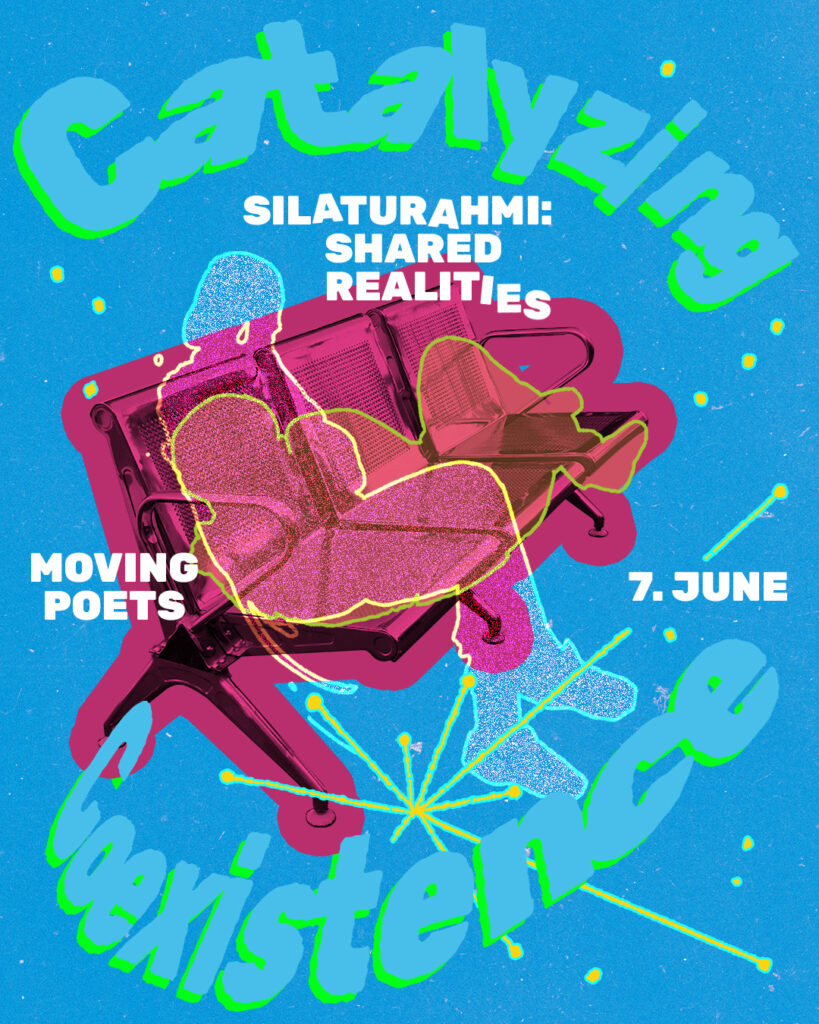
Design by https://aziza.fun/
Chapter 1
SILATURAHMI
(DON’T CALL IT SYMPOSIUM)
7 June 2026, 15:00 – 20:00, Novilla, Berlin. Hasselwelderstr 22 , 12439 Berlin
The first chapter, SILATURAHMI, reimagines what a “symposium” could become when approached through the social and cultural logic of silaturahmi – a term widely understood across Indonesian contexts as the act of reconnecting, maintaining bonds, and acknowledging one another through informal gestures of gathering. Here, silaturahmi becomes both method and proposition.
Moving away from rigid institutional formats, the gathering creates space to meet first as people rather than representatives, experts, or fixed identities. Through conversations, collective listening, food related practices, sound, storytelling, and performances, the programme reflects on the layered realities of diasporic coexistence in Berlin today.
At the same time, SILATURAHMI does not romanticize togetherness. The gathering also opens space for the asymmetries, tensions, unfamiliarities, and negotiations that shape diasporic life itself. Different migration histories, political relationships, class positions, access, and forms of belonging coexist within the same social landscape, often uneasily. Rather than flattening these differences into celebratory multiculturalism, the programme invites participants to remain with complexity and ask how solidarity, proximity, and coexistence can still be practiced across contradiction.
With
Lynhan Balatbat-Helbock
Sarah Hachem
Elizabeth Gallón Droste
Emily Basa Besa, ALPAS Pilipinas
Julianne Chua, AFSAR Study Group (Listening to/Sounding Embodied Archives)
Naima Nazir
Co-curated by
hany tea
Amuleto Manuela
SESSIONS
Session A
On food cultures, crossroads & stories served
Duration: 45 minutes
With
Lynhan Balatbat-Helbock
Sarah Hachem
Moderated by
Amuleto Manuela Garcia
Hosting a dinner is a spatial strategy. To cook is to work through memory and inherited knowledge: selecting ingredients, composing a menu, preparing gestures learned from others. Every ingredient carries a story, the hand that planted it, harvested it, transported it; the soil where it grew; the violences embedded in its cultivation and circulation.
Around the table, strangers, friends, and guests gather with different languages, memories, and sonic backgrounds to share the same meal. In that temporary encounter, food becomes a way of negotiating proximity, difference, and care. Reactions emerge through taste, conversation, silence, discomfort, pleasure. Eating together is also a metabolic process: bodies transforming the same matter in different ways.
Within SILAHTURAHMI (DON’T CALL IT A SYMPOSIUM), Lynhan Balatbat-Helbock, Sarah Hachem, and Amuleto Manuela come together to reflect on food cultures as spaces of encounter, tension, and transmission. Through shared dishes, conversations, and listening, we will think about what it means to gather different histories and bodies around food, and how these encounters reshape the social, sonic, and sensory landscape of a space.
Session B
On listening across distance, difference & solidarities
Diaspora, ecological memory, and climate justice
Duration: 45 minutes
With
Elizabeth Gallón Droste
Emily Basa Besa
Moderated by
hany tea
How do migrant and diasporic communities maintain relationships to land, water, and environmental struggle across distance? What remains carried through sound, storytelling, ritual, memory, and embodied practices while living elsewhere?
Gathering by the Spree in Berlin-Oberschöneweide while listening toward waterways in the Philippines and Colombia, this session brings together artistic, scholarly, and community-based practices shaped by migration, environmental change, and grassroots organising. Moving between conversation and artistic contributions, recordings, readings, reflections, and grounding practices open space to think through ecological memory: the ways relationships to place, environmental knowledge, and sensory histories are carried, transformed, and remembered across movement(s).
The session also reflects on how artistic and cultural practices can articulate environmental and climate justice within diasporic life, and how forms of solidarity are negotiated across different histories, distances, and experiences that do not fully align, yet still attempt to remain in relation.
Session C
(((sssouund)))
Duration: 45 minutes
With
Julianne Chua
AFSAR Study Group (listening to / sounding embodied archives)
The word “sound” contains multitudes: Sound as in vibration of air; to utter, emit—from the Latin sonus: sonnet, sonogram; consonant, dissonant; unison. Sound as in without injury or decay relates to sund, gesund, gesundheit: safe and sound, of sound mind and body. Sound as in a smaller body of water connected to a sea or an ocean; an inlet deeper than a bight, wider than a fjord; a stretch of water one could swim across: Øresund, Stralsund, Core Sound. Sound as in to fathom, probe, explore the cavity of a body, measure the depth of water: sounding line.
In this collective listening session, we reappropriate surveillance technologies to make and maintain connections across frequencies of sound. Participants are invited to bring a word, a character, a script, an emoji, a note, a posture, an image, a taste, a gaze or a phrase embodying what sound means in any language(s) of their choice. Official definitions or examples from your own dictionary of onomatopoeias—both coexist. Through collective acts of sharing, vocalizing, listening and translating, we reflect on how overheard and misheard words operate along the lines of imposed divisions that shape imagined proximities and distances. Which languages travel? Whose accents mark a border? Together, we will negotiate and multiply meanings of sound—in all their paradoxes.
Gathered fragments from the evening will be interwoven into a sonic archive, with future transmissions on ASSOY Radio and AFSAR Radio Moving Hums.
Performance by
Naima Nazir
Timetable
15:00Open doors / arrivals
16:00Welcoming words by hany tea & Amuleto Manuela Garcia
16:15Session A
On food cultures, crossroads & stories served
With Lynhan Balatbat-Helbock and Sarah Hachem
Moderated by Amuleto Manuela Garcia
17:00Short break
17:15Session B
On listening across distance, difference & solidarities
diaspora, ecological memory, and climate justice
With Elizabeth Gallón Droste and Emily Basa Besa
Moderated by hany tea
18:00Short break
18:15Session C
(((sssouund)))
With Julianne Chua, AFSAR Study Group (Listening to/Sounding Embodied Archives)
19:00Poetry performance by Naima Nazir
19:30Dinner together / Ausklang
How to participate
SILATURAHMI is a free admission gathering, but registration is required due to limited capacity.
The event is primarily supported by the IMPACT Program of the Berlin Senate. Like many independently organized cultural projects, the funding often only partially covers the overall production costs. While a large part of the programme is supported, some aspects of the gathering, including food preparation, additional production needs, and the collective labour surrounding the event, still need to be sustained through self organization, donations, and community support.
To help sustain these shared practices and make the gathering possible, we warmly encourage donations starting from 10€.
Please register by filled these form below :